

The March 2026 U.S. Department of State Visa Bulletin determines which immigrant cases can truly move forward this month toward permanent residency. Below is a clear, client-oriented overview for a law firm website, focusing on three pillars: family-based categories, employment-based categories, and the Diversity Visa Lottery (DV‑2026).
1. What Is the Visa Bulletin and Why Does It Matter?
The Visa Bulletin indicates, every month:
- Final Action Dates
These dates determine when a case can be approved (immigrant visa issuance or approval of adjustment of status), provided all other requirements are met. - Dates for Filing
These dates indicate when you may submit documentation to the National Visa Center (NVC) or, in some cases, file adjustment of status with USCIS, even if a visa is not yet immediately available.
In both tables, you compare your priority date (generally the date your family or employment petition was filed) with the date listed in the Bulletin.
If your priority date is earlier than the date shown for your category and country, your case can advance.
2. Family-Based Visas: Situation in March 2026
The annual worldwide limit for family-preference immigration is 226,000 visas. Because demand exceeds supply in several categories, there are wait lists based on priority dates.
2.1. Main Family Categories
The law divides family preferences into:
- F1 – Unmarried sons and daughters (age 21 or older) of U.S. citizens.
- F2A – Spouses and minor children of lawful permanent residents.
- F2B – Unmarried sons and daughters (21 or older) of lawful permanent residents.
- F3 – Married sons and daughters of U.S. citizens.
- F4 – Brothers and sisters of U.S. citizens (petitioner must be at least 21).
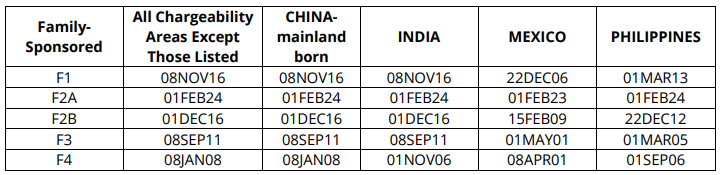
In the March 2026 Bulletin, we see:
2.2. Final Action Dates – Family
In March 2026, family final action dates progress but still show lengthy waits, particularly for Mexico, Philippines, China (mainland-born) and India. Key points:
- F2A (spouses and minor children of permanent residents)
- For most countries, the final action date is February 1, 2024.
- For Mexico, there is a special rule: all F2A visas issued are exempt from the per‑country cap, and the relevant cut‑off date for that exempt group is February 1, 2023.
- This means F2A cases are moving more quickly than many other family categories.
- Other family categories (F1, F2B, F3, F4)
- Show priority dates going back many years (often to the early 2010s or even early 2000s for heavily oversubscribed countries like Mexico and the Philippines).
- This reflects multi‑year waits, making careful legal planning and family strategy essential.
In practical terms:
If your priority date in a family category is earlier than the date listed in the Family Final Action Dates table for your country of chargeability, your case could be approved this month, provided everything else is complete.
2.3. Dates for Filing – Family
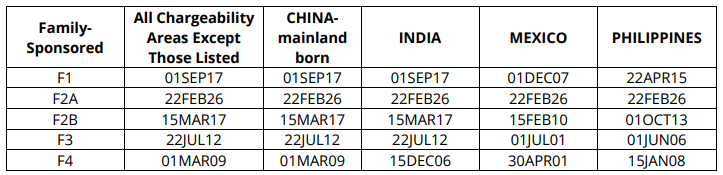
The Bulletin also includes a Dates for Filing chart for family cases. These dates are generally more advanced than final action dates and allow:
- NVC to request civil and financial documents.
- Some applicants inside the U.S. to prepare adjustment of status filings, if USCIS allows use of the filing chart for that month.
For example:
- F2A has a filing date of February 22, 2026 for all countries.
This means many spouses and children of residents—whose priority dates are quite recent—may begin the paperwork process now, even if final approval will come later.
For other categories (F1, F2B, F3, F4), filing dates are also typically ahead of final action dates, enabling families to gain time by preparing the case in advance.
3. Employment-Based Visas: Opportunities and Wait Times
The worldwide annual limit for employment-based immigration is at least 140,000 visas. These are divided into five preference categories:
- EB‑1 – Priority workers (extraordinary ability, outstanding professors/researchers, certain multinational executives/managers).
- EB‑2 – Members of the professions holding advanced degrees, or persons of exceptional ability.
- EB‑3 – Skilled workers, professionals, and other workers.
- EB‑4 – Certain special immigrants (including certain religious workers).
- EB‑5 – Immigrant investors (with sub‑categories for rural areas, high unemployment areas, and infrastructure projects).
3.1. Final Action Dates – Employment
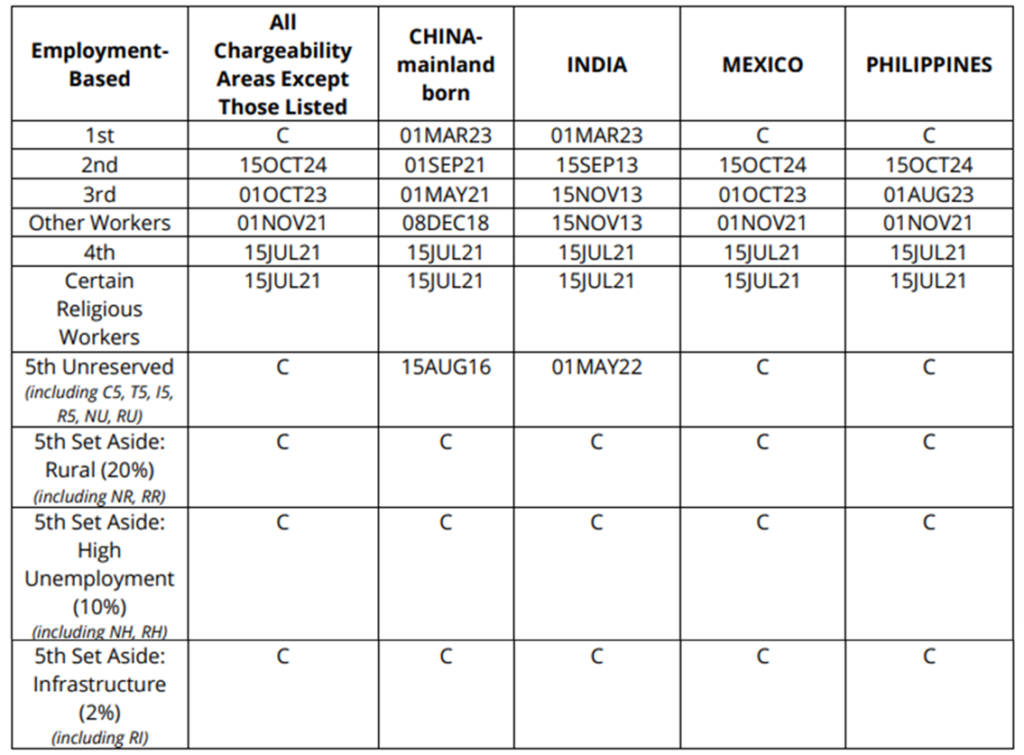
In March 2026, the employment-based final action chart shows:
- EB‑1
- For most countries (other than China and India), the category is “Current” (C), meaning no backlog under the Bulletin; fully documented cases can be approved immediately.
- For China (mainland) and India, there is still a cut‑off date (around early 2023), indicating a shorter but existing queue.
- EB‑2
- For most countries, the final action date is around October 15, 2024, indicating a moderate delay.
- China (mainland) has an older cut‑off (around September 1, 2021).
- India is further retrogressed (around September 15, 2013), showing a significant backlog for Indian nationals in EB‑2.
- EB‑3 (professionals and skilled workers)
- For many countries, the final action date is around October 1, 2023, which is a manageable wait for many professionals, health‑care workers, and technical staff.
- China and India again face much older cut‑off dates and longer queues.
- The “Other Workers” subcategory often has even earlier cut‑off dates due to its separate numerical limit.
- EB‑4 (including religious workers)
- A single cut‑off date applies to all countries, around July 15, 2021, signaling a significant wait.
- The religious workers (SR) program depends on specific legislative authorization; it has been extended through September 30, 2026, keeping this pathway open.
- EB‑5 (investors)
- For most countries, the reserved subcategories (rural, high‑unemployment, infrastructure) remain Current, with no backlog in final action dates.
- In the unreserved EB‑5 category, heavily used countries like China (mainland) and India show specific, older cut‑off dates, while most other chargeability areas are Current.
3.2. Dates for Filing – Employment
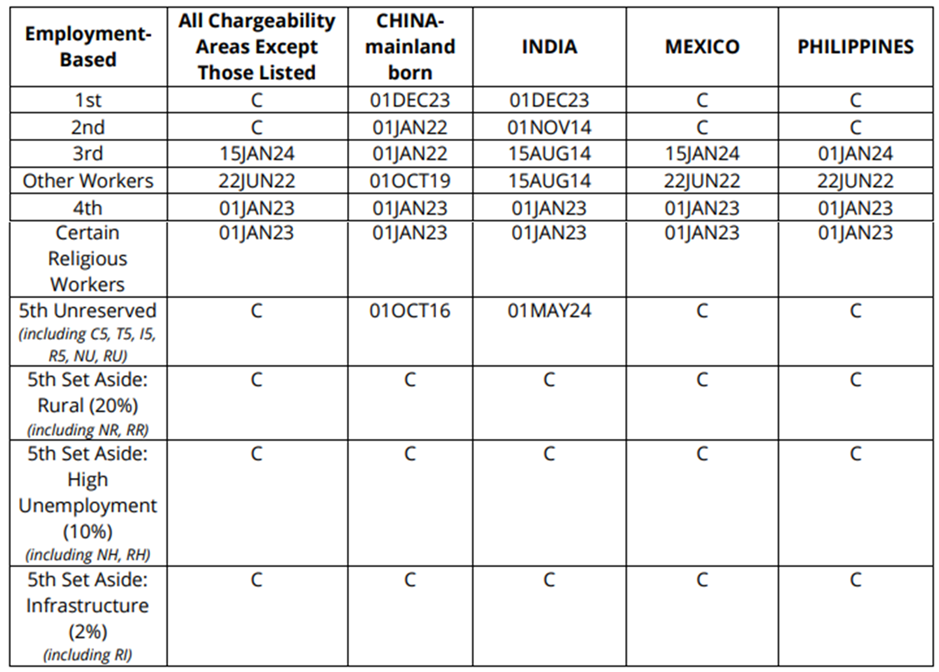
The Employment Dates for Filing chart generally allows applicants to:
- Start submitting documents to NVC.
- In some cases, file for adjustment of status in the U.S., if USCIS authorizes use of that chart for the month.
Highlights:
- In EB‑1, most countries are Current for filing, allowing immediate preparation and filing of complete packages.
- In EB‑2 and EB‑3, filing dates are typically more advanced than final action dates; this lets many professionals start their cases earlier while waiting for a visa number to become available.
- In EB‑5, the reserved subcategories remain particularly attractive: they often show Current status for both filing and, in many instances, final action.
4. Diversity Visa Lottery (DV‑2026)
The Diversity Visa (DV) Program commonly provides up to 55,000 visas per fiscal year to applicants from countries with low levels of immigration to the United States over the prior five years.
For fiscal year 2026:
- Up to 5,000 visas may be used to accommodate certain beneficiaries of special programs (e.g., NACARA).
- Under the NDAA 2024, visas used under certain provisions also count against the DV annual limit.
- As a result, the effective DV‑2026 limit is approximately 52,000 visas worldwide.
4.1. Regional Allocation
DV visas are distributed across six regions: Africa, Asia, Europe, North America (Bahamas), Oceania, and South America/the Caribbean. No single country may receive more than 7% of the total in a given year.
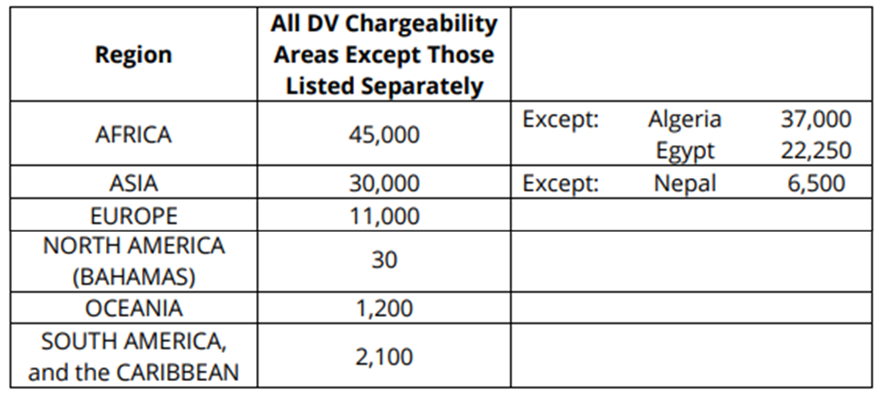
For March 2026, the Bulletin lists up‑to‑cut‑off rank numbers for case processing in each DV region. Illustrative values include:
- Africa – up to about 45,000 (with separate, lower cut‑offs for some countries such as Algeria and Egypt).
- Asia – up to about 30,000 (with a lower cut‑off for Nepal).
- Europe – up to about 11,000.
- North America (Bahamas) – up to about 30.
- Oceania – up to about 1,200.
- South America and the Caribbean – up to about 2,100.
This means that only those selectees whose DV case number falls at or below the published regional cut‑off can move forward with visa interviews or consular processing in March.
4.2. Absolute Deadline for DV‑2026
A critical point for DV selectees:
- The DV‑2026 program ends on September 30, 2026.
- After that date, no DV‑2026 visas may be issued, for principal applicants or derivatives.
- The Bulletin cautions that applicants cannot assume visas will remain available up to the end of the fiscal year—numbers can be exhausted earlier.
Practically, if you were selected in DV‑2026, you should act quickly, completing online forms, medical exams, and interviews without avoidable delay.
5. Overall Context and Possible Changes During the Year
The March 2026 Visa Bulletin explains that:
- Several categories have advanced (both for final action and filing) to help use available immigrant numbers during fiscal year 2026.
- Policy shifts, security considerations, and changing consular workloads can cause future advances or retrogressions—that is, priority dates might later move backward to stay within annual limits.
Because of this, it is essential to:
- Monitor the Bulletin monthly, as the landscape can change.
- Capitalize on periods of advancement to file adjustment of status or provide NVC documentation as early as allowed.
- Develop a personalized immigration strategy, especially if you may qualify under multiple pathways (family, employment, investment, DV).
6. How an Immigration Law Firm Can Help
An experienced immigration law firm can:
- Identify your exact category (F1, F2A, F2B, F3, F4, EB‑1–EB‑5, DV) and country of chargeability, then determine which chart applies to you and what you can do in March 2026.
- Verify your priority date and compare it with:
- The Final Action Dates chart, and
- The Dates for Filing chart.
- Advise on when to file for adjustment of status or consular processing.
- Explore strategic alternatives, such as:
- Shifting employment categories if possible (e.g., from EB‑3 to EB‑2).
- Pursuing marriage‑based or other immediate‑relative options where available.
- Guiding investors through reserved EB‑5 options (rural, high unemployment, infrastructure), which currently show some of the best availability.
- Support you in assembling documentation, responding to Requests for Evidence (RFEs), preparing for interviews, and pursuing appeals or motions where appropriate.
7. Key Takeaways
- The March 2026 Visa Bulletin governs which family‑based, employment‑based, and Diversity Visa cases can progress this month.
- Family categories show long waits in F1, F2B, F3, and F4, while F2A remains comparatively favorable, especially under certain per‑country rules.
- In employment, categories like EB‑1 and many EB‑5 reserved pathways are Current for a wide range of countries, whereas India and China face longer backlogs in EB‑2 and EB‑3.
- The DV‑2026 program functions with an effective cap near 52,000 visas, region‑specific rank number cut‑offs, and a hard end date of September 30, 2026.
- Because cut‑off dates can move forward or backward over time, ongoing monitoring and tailored legal advice are crucial.